
Killeen Previous Residents by Era
Previous residents of a Killeen address are best traced through source types that have different time ranges. Bell County's current Official Records portal supplies recorded-instrument searching, but its inspected page does not state the first online deed-index year. Printed directories are snapshots of selected years. Federal census schedules provide a historical family layer through 1950, while Sanborn maps supply block and building context rather than names. When an online index stops, the documented fallback is the County Clerk, counter or mail route, microfilm or archival research, and local-library or historical-society material.
| Source | Years it covers | Where held | What it shows |
|---|---|---|---|
| Bell Official Records | Current portal; first online year not located | PublicSearch and Bell County Clerk fallback | Recorded instruments, parties, dates, and legal-description clues |
| TSLAC Killeen directories | 1963, 1982, 1990 | TSLAC reading room | Published name, address, phone, and other printed fields when present |
| UT Polk directory citations | 1965, 1970, 1972, 1974, 1976-1981, 2003 | UT Briscoe directory index | City-directory item leads; image availability varies |
| LOC Killeen Sanborn maps | January 1926-September 1937 | Library of Congress | Street, block, building, and use context, not occupants |
| Federal census | 1790-1950 released | Census, NARA, and library databases | Enumerated families and geography, subject to date and boundary limits |
Choose the entry point by the date. A recent parcel lead belongs in CAD and the Clerk index. A mid-century family question may begin with a directory citation, then move to a census, newspaper, or deed. Earlier street research may need a map sheet, deed-book help, and archive context. No source by itself proves the whole chain.
Killeen Previous Residents and Old Labels
Address matching needs special care in Killeen. The original Santa Fe plat covered 360 acres and 70 blocks, and long, narrow downtown lots can persist in a modern parcel shape. Older material can use Fort Hood, while current material may use Fort Cavazos. Postal city labels can differ from city limits. Preserve the original address and place label first. Then build a dated crosswalk using the parcel's legal description, lot and block, subdivision, or map sheet rather than assuming a modern street label resolves every older record.
Parcel splits, replats, combinations, annexations, and renamed streets can create more than one CAD identifier for what looks like one address. Compare legal-description text and its date before joining records. The city GIS helps place a parcel and its boundaries, but the public service does not publish a household-occupant layer. Its proper role is geographic context.
Note: Keep the event date, deed recording date, directory compilation year, map date, and portal access date as separate fields in the trail.
Killeen Previous Residents in Deeds
The Bell County Clerk recorded-searches page routes users to Official Records, older-record guidance, and Clerk request channels. In Bell Official Records, Quick Search and Advanced Search use a Search Term plus recorded-date filters. A term can be a grantor, grantee, subdivision, document type, or document number. Index Only is suited to normalized names and document numbers. Index & Full Text uses OCR and can surface words inside scans, so it may return text from a legal description or acknowledgment rather than the party sought.
Search surname variants separately, including initials, punctuation changes, middle names, entity names, and subdivision names. Record the document type, instrument number, parties, recorded date, book or page if displayed, and legal-description clues. A document date and recorded date are not always the same. The portal displayed certification through August 31, 2026 during research; that is a portal status, not a historical coverage start.
The Clerk's recorded-search channels identify the official online and fallback routes.
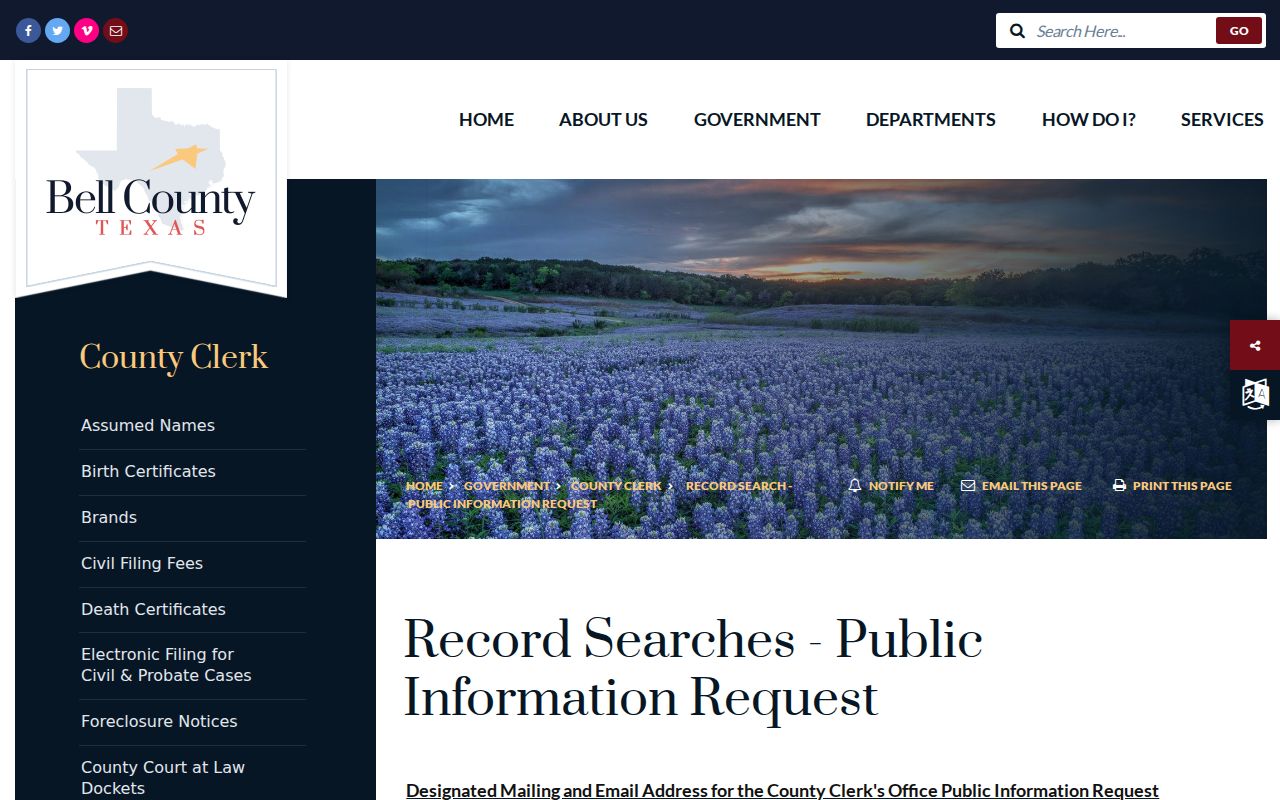
The official page is the right starting point when an older book, copy, or county assistance is needed beyond the online search.
Bell County Deed Chain Method
A chain of title is the recorded sequence of transfers or related instruments for a parcel. Begin with a current Bell CAD result only as an appraisal lead. CAD can show owner and mailing fields, a situs address, parcel identifiers, tax year, and legal-description cues, but it is not title proof. The mailing field is where notices go and does not identify a current occupant. Use the address and legal description to find the acquisition instrument, then walk backward through the grantee side of the index.
- Find the current CAD account and save the property or geographic ID, situs address, and legal description.
- Search the listed owner as grantee near the acquisition date in Official Records.
- Open or request the instrument and record the grantor, recorded date, instrument number, and legal description.
- Search that seller as grantee in earlier records to locate the prior acquisition.
- Repeat while comparing lot, block, subdivision, or metes-and-bounds wording. Move to Clerk help, older books, microfilm, or archives when the online trail ends.
- Grantor and grantee
- The grantor transfers an interest. The grantee receives it. Both labels must be read in the context of the specific instrument.
- Chain of title
- A dated sequence of recorded instruments connected by the same legally described parcel, not merely a repeated street address.
- Legal description
- The lot, block, subdivision, or metes-and-bounds description used to distinguish the parcel when a street label changes.
Trustee deeds, probate, divorce, survivorship, liens, releases, plats, replats, and entity-name changes may interrupt the simple buyer-and-seller pattern. Do not link two records until the dated legal description supports it.
Killeen Past Residents on Maps
Maps can translate an older Killeen address into its street and block context. The Library of Congress Killeen Sanborn item covers seven sheets from January 1926 through September 1937. A Sanborn sheet can show building footprints, street labels, block relationships, uses, and fire-protection details. It cannot establish who lived there. Use its exact sheet and date beside the directory or deed observation it helps interpret.
TSLAC also lists eight Killeen map records from 1952-1992, including highway, city, subdivision, and water-plan material. Many records do not have an image, so a catalog result may require a request. Align old block and street labels with modern GIS only after retaining both labels in the research note. That preserves the historical evidence instead of overwriting it.
Note: A map adds location context. It does not prove ownership, occupancy, or a person's identity at an address.
Killeen Previous Resident Households
Recorded owners are only one part of an address history. Directories, phone books, yearbooks, census schedules, cemetery material, and obituaries can supply a separate dated observation of a family or former resident. The confirmed collections are described on the Killeen city directories page, while this trail uses them to test a specific address over time. A printed entry proves only that the source listed the name and address in that edition. It does not establish current occupancy, and it should not be joined to another same-name entry without a second signal.
- Start with a directory year closest to the address event and transcribe the entry exactly.
- Check the next available directory year and any address-ordered section for the same street spelling.
- Pair that dated observation with the nearest released census, retaining the enumeration place and date.
- Use a deed, original newspaper item, cemetery document, or permitted vital record only to corroborate the timeline.
Federal schedules through 1950 are public under the 72-year rule as of 2026. Killeen's military-area growth and changing geographic labels mean an enumeration location may not match today's city limits. A gap in the printed record can mean a move, a different listing form, an unlocated volume, or a missing digital item. State that limitation instead of inventing a conclusion.
Killeen Previous Residents in Archives
The Bell County Historical Society is the strongest local archive lead for address history. Its in-house resources include the Gateway Index, yearbooks, phone books, local history, biographies and general research, regional history, and family history. Staff gather materials after a Research Topic Form and an appointment. Killeen Library's catalog and reference desk are another route for local-history shelves, newspaper microfilm, yearbooks, and vertical files. These access channels matter when an online index has no result.
Volunteer genealogy material can provide a name, date, or place lead, but the original image or custodian source should be sought. The Killeen Daily Herald page at UNT has a title range of 1953-current but only a visible 1982-1992 digital run. Search the exact surname, street, organization, and date. Cite the item found, not the entire newspaper title, and use library or archive routes for a missing year.
Killeen Previous Residents Trail Endpoints
Cemetery, obituary, probate, and vital-record references can close or refine a historical trail, but each has access limits. Killeen City Cemetery publishes an all-interments document and a grave-map request route. Its 1942 transfer of 768 bodies from 15 Camp Hood cemeteries is a distinctive local clue: a moved interment may bridge a family history when the original military-area cemetery is no longer visible. It is still not proof that a person lived at a particular Killeen address.
Bell County's Permitium landing page is the local vital-record ordering route, while Texas DSHS has separate statewide eligibility rules. Birth records are generally public after 75 years and death records after 25 years under Texas Government Code Section 552.115. Protected copies require an eligible requester, and a public-information request cannot bypass those rules.
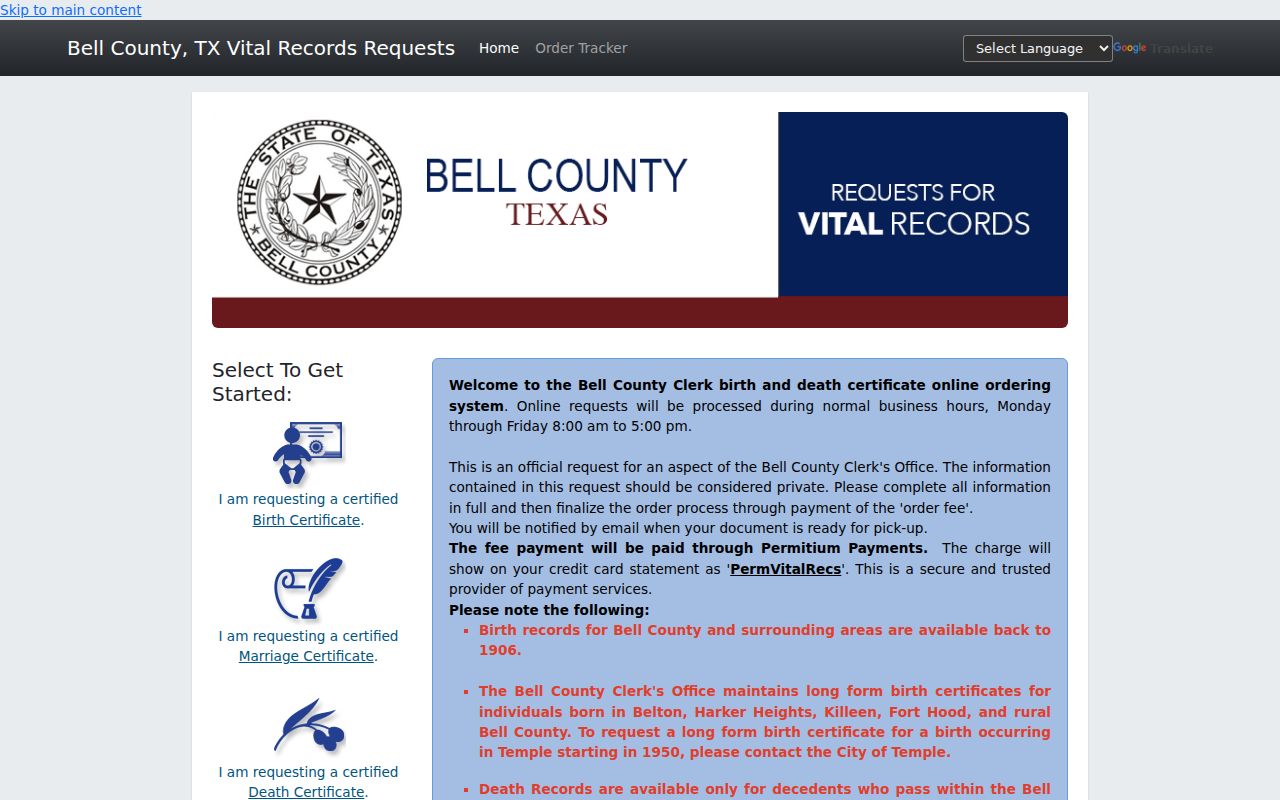
The blank ordering view illustrates a custodian route, not a source for bypassing certificate eligibility.
Custody sources require an even narrower reading. A Bell County booking result can corroborate a time-bound event, but it is not an address history or a court disposition. The jail inquiry does not publish a complete historical retention cutoff, so a missing result cannot prove that no booking occurred.
Bell County New World Inmate Inquiry is the official local custody search surface.
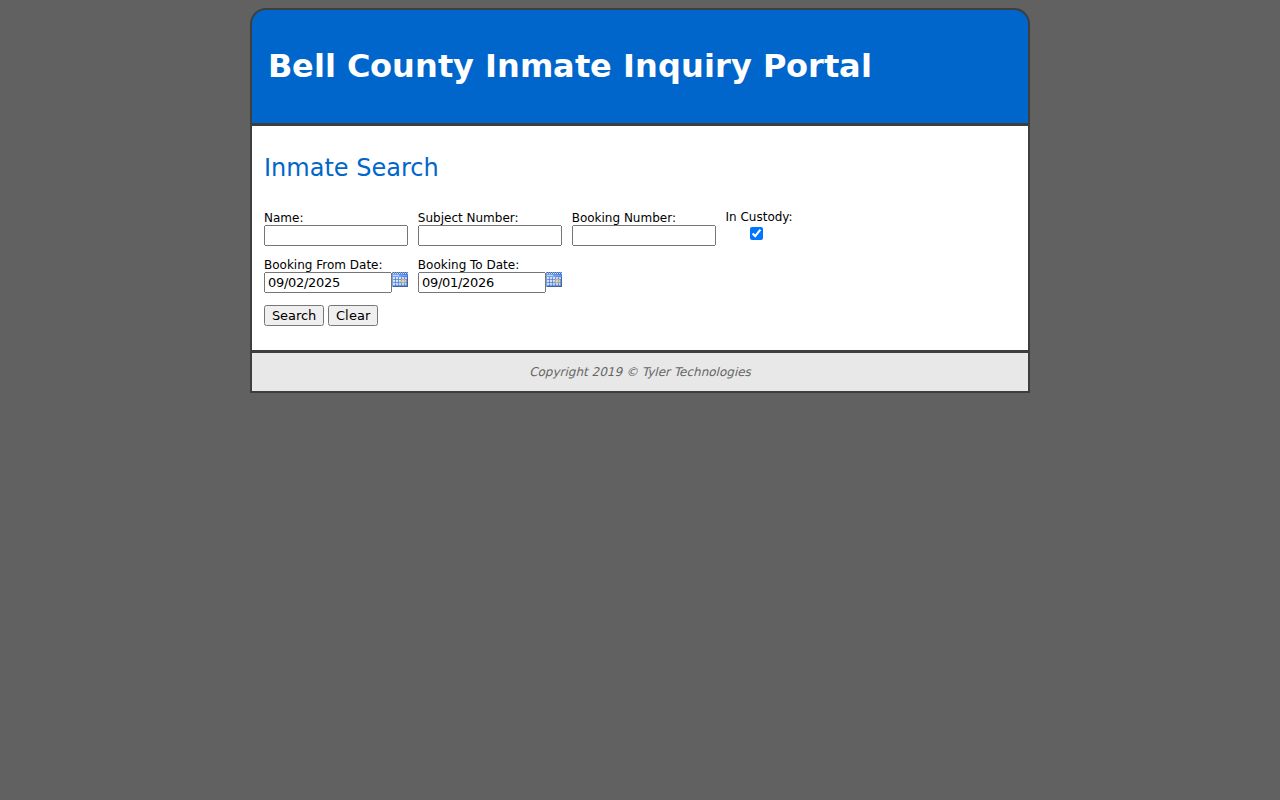
Use a booking screen only to identify its limited search scope, then verify any case outcome through the correct court or Clerk record.
Killeen Previous Residents Legal Limits
Address-history research is suitable for family history, estate questions, neighborhood history, and personal curiosity when records are used lawfully. It must not become a way to track or harass a living person. Do not publish protected addresses, confidential voter details, juvenile material, utility account information, or private contact information. A CAD owner row, mailing field, deed, map, or old directory entry does not establish that someone is currently at an address.
For a current address-level record chain, use the Killeen by-street directory and retain its same appraisal and occupancy cautions. For an unsuccessful search, record the exact index, date range, spelling, and access date, then say that the record was not located in that searched scope.