
Killeen City Directory Holdings
Killeen city directories survive in separated groups, not one uninterrupted shelf. The Texas State Library and Archives Commission, known as TSLAC, identifies three Killeen volumes. UT Briscoe identifies a different run of R. L. Polk & Co. citations. The Bell County Historical Society also keeps phone books, yearbooks, its Gateway Index, and local-history material for in-house research. Treat each listed year as a distinct observation. A missing year may reflect a catalog gap, a volume held elsewhere, or an edition that has not been located, rather than proof that nobody lived at an address.
| Collection | Years documented | Where held | How to use it |
|---|---|---|---|
| Killeen directories | 1963, 1982, 1990 | Texas State Library and Archives Commission | Reference collection onsite; remote lookups are not offered |
| R. L. Polk & Co. Killeen City Directory | 1965, 1970, 1972, 1974, 1976, 1977, 1978, 1980, 1981, 2003 | UT Briscoe directory index | Search the citation; image availability varies |
| Phone books, yearbooks, Gateway Index | Years not published as a complete run | Bell County Historical Society | In-house material after a Research Topic Form and appointment |
| Killeen Daily Herald items | 1982-1992 visible digital items | UNT Portal to Texas History | Search the title and item records; the digital run is limited |
Start with the year closest to the event being researched. For a family known in the 1970s, the Polk citations give several nearby checkpoints. For a name tied only to 1963, 1982, or 1990, TSLAC is the direct directory route. The historical society and Killeen Library are useful when a catalog search does not reveal the needed volume.
TSLAC's Killeen holdings list identifies the three state-library volumes.
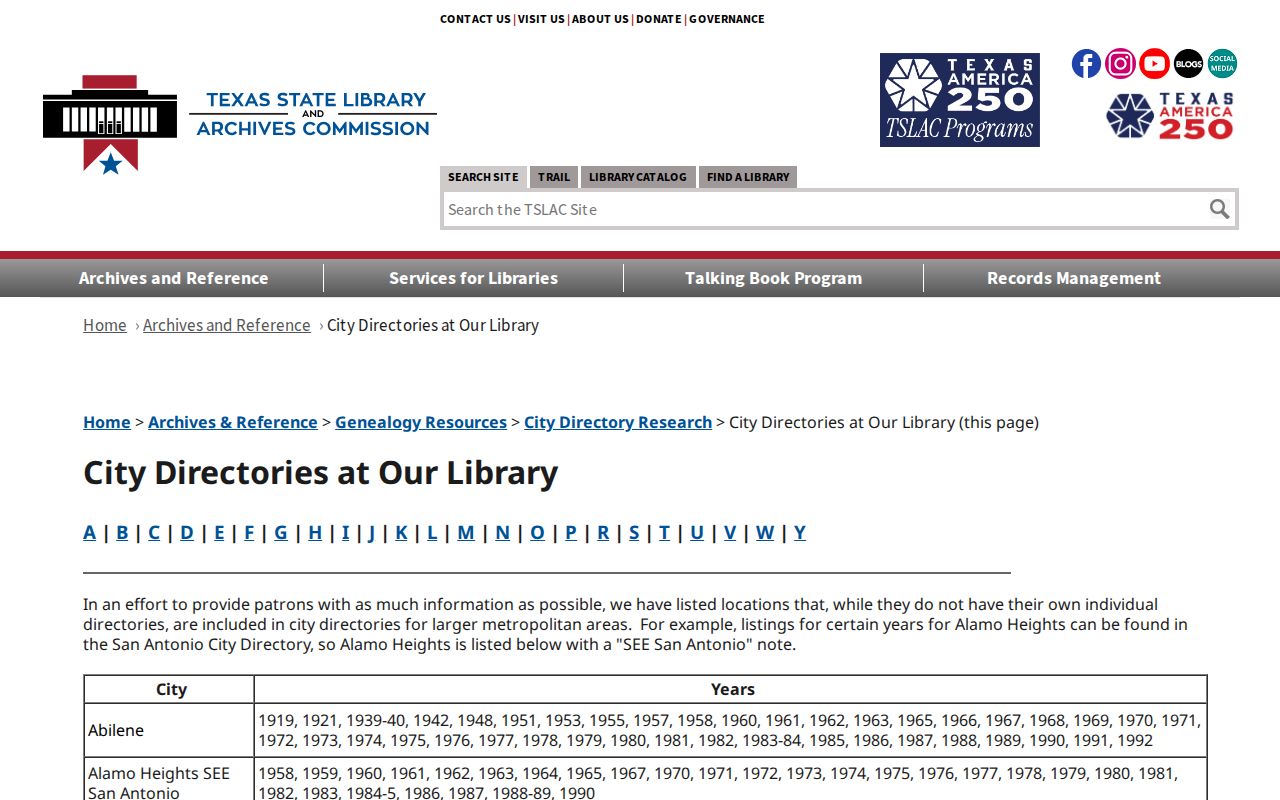
The holdings screen is a useful confirmation of repository and year, not evidence of a continuous Killeen run.
Killeen City Directory Years at UT
The UT Briscoe index offers a practical way to narrow an archival request before travel. Its controls allow a location, directory type, and from-to year search. The Killeen citation names R. L. Polk & Co. and lists Killeen and Copperas Cove as locations. That shared location label matters: record the place exactly as the citation gives it instead of silently treating every Copperas Cove reference as a Killeen address.
Use the citation date and publisher as part of the research note. A catalog result establishes that an item is described in the index. It does not establish that an open scan, a reverse section, or a complete page is available online. Ask for the item record or a permissible image, and preserve its page reference with the transcription.
UT Briscoe's Killeen directory citation displays the Polk title, locations, and documented publication dates.
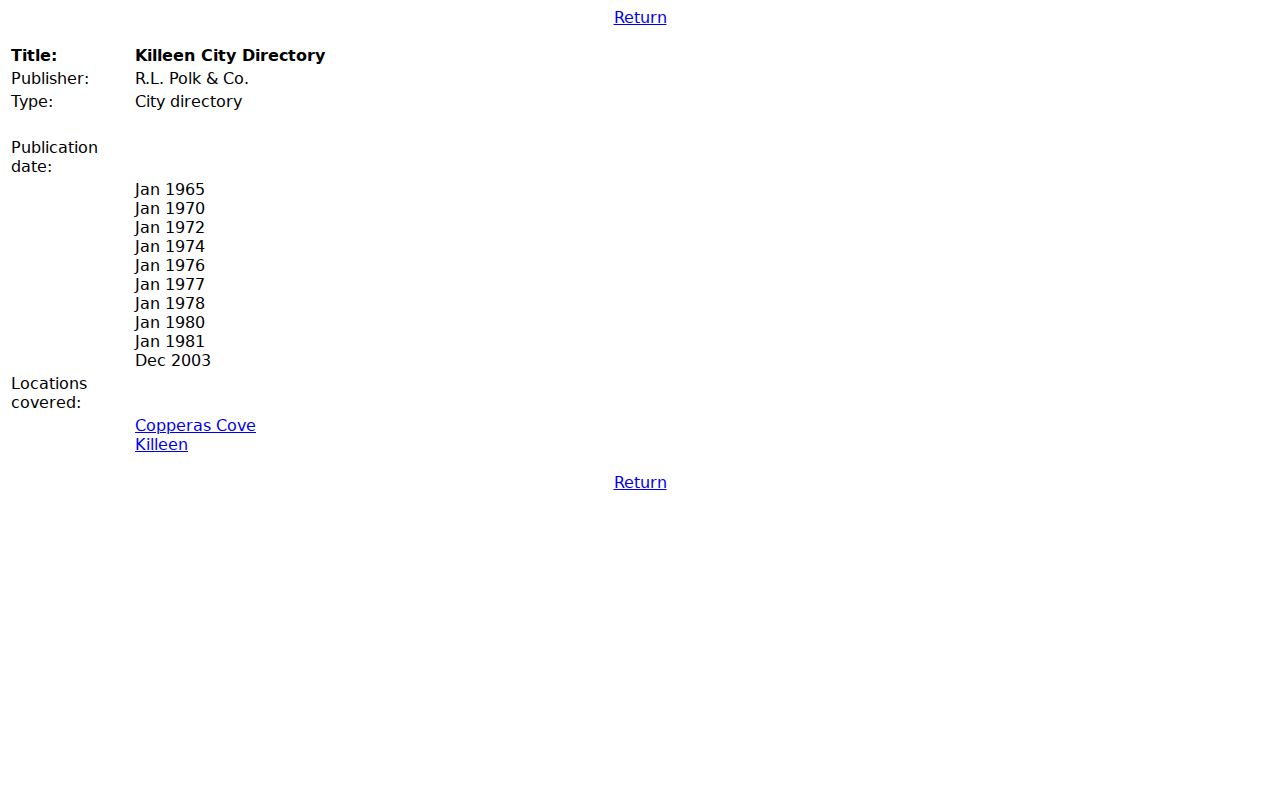
Use the citation as a request lead, then verify the edition and access status with the repository.
Note: Killeen's confirmed directory years contain gaps, so avoid describing the Polk list as an annual series.
Accessing Killeen City Directory Archives
There are several access channels when a directory search begins online but stops there. Killeen Library's catalog is the local starting point, while the reference desk can be asked about local-history shelving, newspaper microfilm, yearbooks, and unindexed vertical files. The library lists reference at 254-501-8808 and circulation at 254-501-8996. Its electronic-resource page identifies FamilySearch, Portal to Texas History, TexShare databases, and PressReader, but it also carried an access-suspension notice during research. Check access before a visit.
TSLAC does not perform city-directory lookups or transcriptions by phone or email. Its Austin reading room and other university or library repositories are the appropriate fallback. The Bell County Historical Society's onsite resources require an appointment and Research Topic Form; staff then gather in-house material. That process is more useful than assuming a broad web search has already covered a local name.
UT Briscoe's directory index shows the location, directory-type, and year controls used to begin a catalog search.
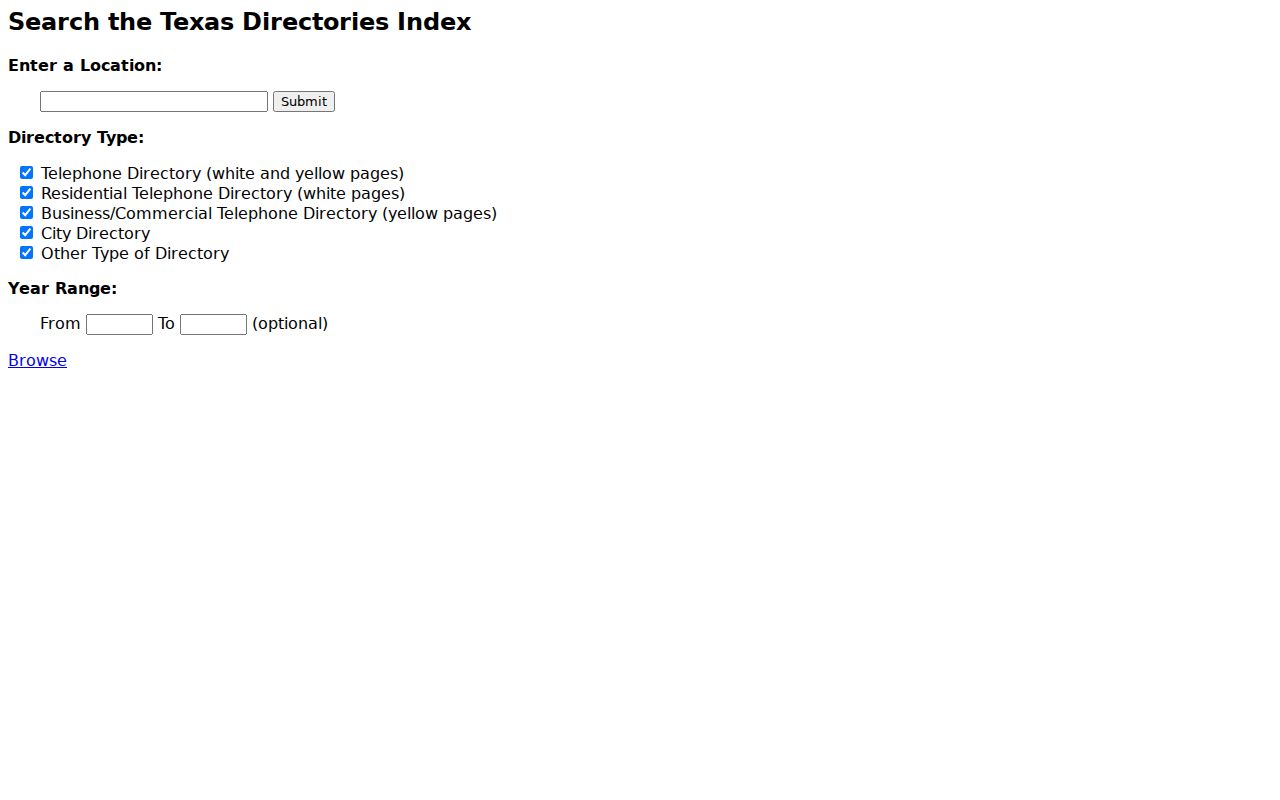
Set the location and year range first, then check the specific citation rather than assuming every result has a digital image.
Reading a Killeen City Directory
A Killeen city directory is a published observation, not a current identity report. TSLAC explains that directories can include a name, address, phone, spouse, occupation, and ownership information. The exact mix changes by volume. No inspected source exposed a Killeen household scan with local abbreviation marks, so do not copy an abbreviation rule from a different city. Photograph or note the volume's own key before interpreting a symbol, relationship notation, or street section.
| Printed name | Transcribe surname, initials, and given name exactly, including punctuation. |
|---|---|
| Address | Keep the street spelling, number, unit, and edition year together. |
| Relationship notation | Record any spouse or relationship notation only as printed. |
| Occupation or organization | Capture it when the volume displays it, without inferring a relationship or later status. |
| Ownership notation | Preserve any mark only after checking the edition's abbreviation key. |
- Criss-cross directory
- An address-ordered section that can connect a printed street address to an entry for that edition year.
- Householder index
- An index arranged around the listed household or address, whose scope depends on the particular volume.
- Abbreviation key
- The volume's guide to its shortened labels. It should be read before a mark is assigned a meaning.
Killeen Directory Addresses Need Context
Killeen's address history has local complications. The original Santa Fe plat covered 360 acres and 70 blocks, and its downtown lots were often long and narrow. Older sources may also use the dated Fort Hood name while current sources use Fort Cavazos. Keep the source's original place label. A postal label, military-area reference, or narrow historic parcel is not a reason to rewrite a directory entry into a modern address.
The Library of Congress holds seven Killeen Sanborn sheets dated from January 1926 through September 1937. Those maps provide building, block, street, and use context for an old address, but they are not resident lists. Pair the map sheet date with the directory's compilation year, then use the city GIS and recorded documents only for a carefully dated geographic cross-check.
A reader moving from an old address to a current parcel can use the Killeen by-street directory for the modern parcel and deed workflow. Keep that modern trail separate from the printed historical entry.
Killeen City Directory Gaps Matter
It is tempting to turn separated holdings into a smooth timeline. The research does not support that. The first and last Killeen directory years were not located as a continuous run. TSLAC confirms 1963, 1982, and 1990, while UT confirms selected Polk citations through 2003. Exact local reverse-directory years were not located. A blank interval may reflect missing publication, a repository gap, a catalog record without a scan, or a volume that needs an onsite search.
The Killeen Daily Herald is another useful but limited companion. Its title page spans 1953-current, yet the visible digital items are only 1982-1992 and 232 pages. Search an exact surname, street, organization, and date. Cite the item and date that appear, not an assumed full issue run. Library microfilm and archive appointments remain the fallback for missing years.
Note: Write “not located in the searched collection and year range,” rather than treating a missing catalog result as proof of absence.
Trace Killeen City Directory Families
Family-history work is strongest when it proceeds in dated steps. Start with an exact transcription, including the edition and page or entry location. Search the next available Killeen volume for the same name and street, then check the address-ordered section if that volume has one. A move, a spelling change, initials, a military-installation label, or a Copperas Cove label can create a false break. Use two independent signals, such as a dated address plus a spouse notation or a deed, before treating entries as the same person.
- Transcribe the first entry exactly and record the directory year, page, and repository.
- Check the nearest available volume on either side of that year for the surname and street spelling.
- Compare any address-ordered section with the name entry, while preserving its edition date.
- Pair the directory observation with the nearest released federal census, accounting for its enumeration geography.
- Use a dated deed, cemetery record, obituary, or original archival image only as corroboration.
Federal individual census schedules through 1950 are public under the 72-year release rule as of 2026. They may not use today's Killeen boundaries, especially near military areas. A name that disappears from one directory may indicate a move, death, changed listing practice, or an unlocated edition. It does not answer which explanation is correct by itself.
Verify Killeen Directory Findings
Use a directory finding as the first dated observation, then test it against an independent source. The Bell County Historical Society, Killeen Library, TSLAC, UT Briscoe, the Library of Congress, and UNT each hold a different kind of evidence. The source hierarchy is useful here: an original record image or government document is stronger than an index, and an established archive catalog is stronger than an unverified transcription. Preserve the search terms, source URL, access date, and result status even when the search is negative.
For a person who may still be current, confirm only through lawful custodian routes and avoid treating an old printed address as a current location. A modern record check belongs with the Killeen resident lookup workflow, where current official indexes and privacy limits can be considered separately.